Education Website Development Company for K–12, Higher Ed & Edtech Platforms
Inovexa Tech is a U.S.-based education website development company creating fast, accessible, and secure websites for schools, colleges, and universities. With WCAG 2.1 compliance, FERPA-aware data handling, and seamless LMS integration, we build websites designed for modern education.
What Is Education Website Development — and What Does It Actually Involve?
Education website development goes beyond a standard website, requiring student portals, admissions tools, LMS integrations, accessibility, FERPA compliance, and easy-to-manage content systems. Inovexa Tech handles the full process in-house, from UX and integrations to accessibility, QA, and ongoing support.
What are you waiting for?
Don’t Have A Website Or App ?
Let’s Discuss How We Can Help Bring Your Project Life
Who Inovexa Tech Builds For
K–12 Schools and Districts
Inovexa Tech builds modern K–12 school websites with parent-friendly navigation, event calendars, staff directories, enrollment forms, and emergency alerts. Our easy-to-manage CMS lets teachers and administrators update content quickly without any coding.
Colleges and Universities
Inovexa Tech develops scalable higher education websites with admissions workflows, student and faculty portals, course catalogs, research pages, and WCAG 2.1 accessibility. We work closely with university IT and academic teams to deliver secure, easy-to-manage websites that grow with your institution.
Edtech Platforms
Inovexa Tech builds high-converting edtech websites that showcase your product, simplify onboarding, and drive demos, trials, and signups. Designed for educators, administrators, and learners, our websites clearly communicate value while delivering a seamless user experience.
Online Course Providers
From course landing pages and learner dashboards to payment gateway integrations and digital learning environments, Inovexa Tech builds the full set of pages and features an online course business needs to look professional and scale with ease.
What are you waiting for?
Don’t Have A Website Or App ?
Let’s Discuss How We Can Help Bring Your Project Life
Key Features Built Into Every Education Website
These capabilities come standard across Inovexa Tech’s education website projects:
- Student and Parent Dashboards — Personalized, role-based portals for grades, schedules, announcements, and resources, built with clear information hierarchy so users find what they need without friction.
- LMS Integrations — Documented, tested connections with Canvas, Moodle, Blackboard, Google Classroom, and more, so your website and digital learning environment work as one unified experience.
- Student Information System (SIS) Integrations — Links to SIS platforms that keep enrollment data, course rosters, and student records synced across your infrastructure.
- Admissions and Enrollment Forms — Mobile-optimized, accessible forms designed to reduce drop-off and capture the data your admissions team actually uses, with conditional logic, file uploads, and CRM or SIS integration where needed.
- ADA/WCAG 2.1 Accessibility — Sites are built to meet WCAG 2.1 Level AA, the benchmark referenced by Section 508 of the Rehabilitation Act and the Americans with Disabilities Act (ADA) for digital accessibility. Accessibility is validated through both automated tooling and manual testing before launch.
- FERPA-Aware Data Handling — Student data privacy is addressed at the architecture level — from form field design and storage practices to third-party tool vetting and access control — in alignment with FERPA guidelines.
- Event Calendars — Filterable, easy-to-manage calendars that keep your community informed, with category filtering by school, department, or event type.
- Academic CMS for Faculty and Staff — Content management configured for non-technical users, so updating a course description, faculty bio, or news post never requires IT. Platform choice (WordPress, Drupal, or custom) is based on your scale and internal capabilities.
- Responsive Design Across All Devices — Layouts tested across desktop, tablet, and mobile, so the site performs beautifully whether a parent checks the calendar on a phone or a faculty member edits a page at a library workstation.
- Performance Optimization — Built with core web vitals in mind: optimized images, efficient code, and caching that keeps load times fast even during enrollment surges or major announcements.
- Post-Launch Support and Documentation — Ongoing support for fixes, features, and updates, plus documented CMS training and handover materials so your team can manage content with confidence.
Our Development Process
01
02
03
04
05
1. Discovery and Scoping
Every project starts with a structured discovery phase to define requirements, integrations, scope, accessibility, security, and branding standards.
2. Design and Prototyping
Next, we create wireframes and high-fidelity mockups tailored to your brand and audience. You review and approve the design before development, reducing costly revisions later.
3. Development and Integration
Development uses a secure, scalable platform with LMS, SIS, forms, calendars, and portals integrated and tested throughout the build.
4. QA & Compliance Review
Before launch, every site goes through functional, performance, accessibility, and FERPA-alignment testing to identify and resolve issues before users encounter them.
5. Launch and Ongoing Support
Inovexa Tech manages the full launch, from DNS and SSL setup to redirects and post-launch checks, with ongoing support for maintenance, updates, new features, and accessibility monitoring.
Why Choose Inovexa Tech as Your Education Website Development Partner?
Sector-specific expertise
Inovexa Tech works within education — K–12 schools, colleges, universities, edtech platforms, and online learning providers. That focus means your project team already understands academic IT governance, FERPA obligations, LMS ecosystems, and the reality of running a school’s digital presence under tight budgets.
Accessibility built in from day one
WCAG 2.1 isn’t a final checklist item here — it’s woven into design decisions, component architecture, and CMS configuration throughout the project, then validated with both automated tooling and manual testing.
A CMS your staff will actually use
One of the most common failure points in education projects is a CMS non-technical staff can’t confidently operate. Inovexa Tech configures interfaces around the people who use them daily, so faculty and administrators can update course pages, news posts, event listings, and directories without IT support.
Serious attention to student data privacy
FERPA alignment isn’t a slogan — it takes deliberate choices about how student data is collected, stored, accessed, and shared. Inovexa Tech addresses these at the architecture level and vets third-party tools before recommending them.
Designed for long-term institutional use
Education websites need to grow with new programs, larger enrollment, updated accessibility standards, and changing LMS platforms. Sites are built on scalable architectures, with ongoing development available so your website never becomes a limitation.
Custom Development vs. Template-Based Solutions: Which Is Right for Your Institution?
The short answer: templates fit smaller, simpler sites, while custom development fits institutions with real integration and compliance needs.
Template-based solutions — pre-built WordPress themes or website builders — can work for smaller institutions with limited budgets, straightforward content, and minimal integrations. They deliver faster turnaround and lower upfront cost, but they often require workarounds for complex integrations, offer limited accessibility customization, and may clash with branding or IT security standards.
Custom development suits institutions that need LMS or SIS integrations, WCAG 2.1 compliance validated through manual testing, role-based student and faculty portals, admissions workflows, or a CMS configured for non-technical governance. It costs more upfront and takes longer, but it avoids the compounding cost of maintaining a platform that never quite fits.
WordPress vs. Drupal for Education Websites
WordPress is the better fit for K–12 schools, smaller colleges, and edtech platforms that value ease of use for non-technical editors, faster deployment, and a large ecosystem of supported plugins. It’s the friendlier platform for staff-managed content governance.
Drupal is the better fit for large universities and complex higher education environments that need granular user permissions, multi-site management across departments or campuses, robust content governance workflows, and tighter integration with enterprise IT. Its architecture shines where content structure and access control are critical.

Common Education Website Challenges — and How Inovexa Tech Addresses Them
Content governance at scale
Large institutions struggle to keep content current across dozens of departmental pages. Inovexa Tech solves this with structured CMS role configurations — editing permissions assigned by department or content type — plus documentation and training that reduce reliance on central IT for routine updates.
Accessibility maintenance over time
WCAG compliance isn’t a one-time win. As staff add and update content, new accessibility issues can slip in. Inovexa Tech offers guidance on accessibility-aware content authoring and can implement monitoring tools that flag issues as they appear, not just at launch.
Website migration from legacy platforms
Moving off an outdated CMS or custom legacy system takes redirect mapping, content audits, data migration, and re-established integrations. Inovexa Tech manages migrations with a structured approach that minimizes downtime and protects search visibility through correctly configured 301 redirects.
Performance under high-traffic periods
School websites see concentrated spikes during enrollment windows, back-to-school season, and major announcements. Sites are load-tested against anticipated peak traffic and configured with caching and content delivery infrastructure that matches your scale.
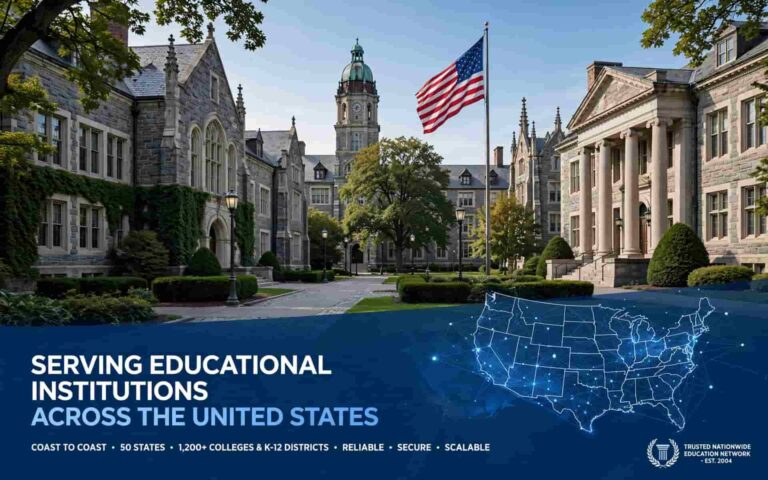
Serving Educational Institutions Across the United States
Inovexa Tech partners with schools, universities, and edtech organizations across all 50 U.S. states, including Alabama, Alaska, Arizona, Arkansas, California, Colorado, Connecticut, Delaware, Florida, Georgia, Hawaii, Idaho, Illinois, Indiana, Iowa, Kansas, Kentucky, Louisiana, Maine, Maryland, Massachusetts, Michigan, Minnesota, Mississippi, Missouri, Montana, Nebraska, Nevada, New Hampshire, New Jersey, New Mexico, New York, North Carolina, North Dakota, Ohio, Oklahoma, Oregon, Pennsylvania, Rhode Island, South Carolina, South Dakota, Tennessee, Texas, Utah, Vermont, Virginia, Washington, West Virginia, Wisconsin, and Wyoming.
Frequently Asked Questions
Common Customer Concerns
